

As the craze of earnings season draws to a close, here’s a look back at some of the most exciting (and some less so) results from Q2. Today, we are looking at therapeutics stocks, starting with Amgen (NASDAQ:AMGN).
Over the next few years, therapeutic companies, which develop a wide variety of treatments for diseases and disorders, face strong tailwinds from advancements in precision medicine (including the use of AI to improve hit rates) and growing demand for treatments targeting rare diseases. However, headwinds such as rising scrutiny over drug pricing, regulatory unknowns, and competition from larger, more resourced pharmaceutical companies could weigh on growth.
The 11 therapeutics stocks we track reported a very strong Q2. As a group, revenues beat analysts’ consensus estimates by 8%.
Luckily, therapeutics stocks have performed well with share prices up 26.4% on average since the latest earnings results.
Amgen (NASDAQ:AMGN)
Founded in 1980 during the early days of the biotechnology revolution, Amgen (NASDAQ:AMGN) is a biotechnology company that discovers, develops, and manufactures innovative medicines to treat serious illnesses like cancer, osteoporosis, and autoimmune diseases.
Amgen reported revenues of $10.05 billion, up 9.5% year on year. This print exceeded analysts’ expectations by 6.9%. Overall, it was an exceptional quarter for the company with full-year revenue guidance exceeding analysts’ expectations and a solid beat of analysts’ full-year EPS guidance estimates.
"Our results demonstrate strong performance across our business. Our six key growth drivers grew 26% year over year, generating nearly 70% of second-quarter product sales. As we expand the potential of our existing medicines through new indications and advance the next wave of pipeline molecules through Phase 3, we remain confident in our ability to deliver growth well into the next decade," said Robert A. Bradway, chairman and chief executive officer.
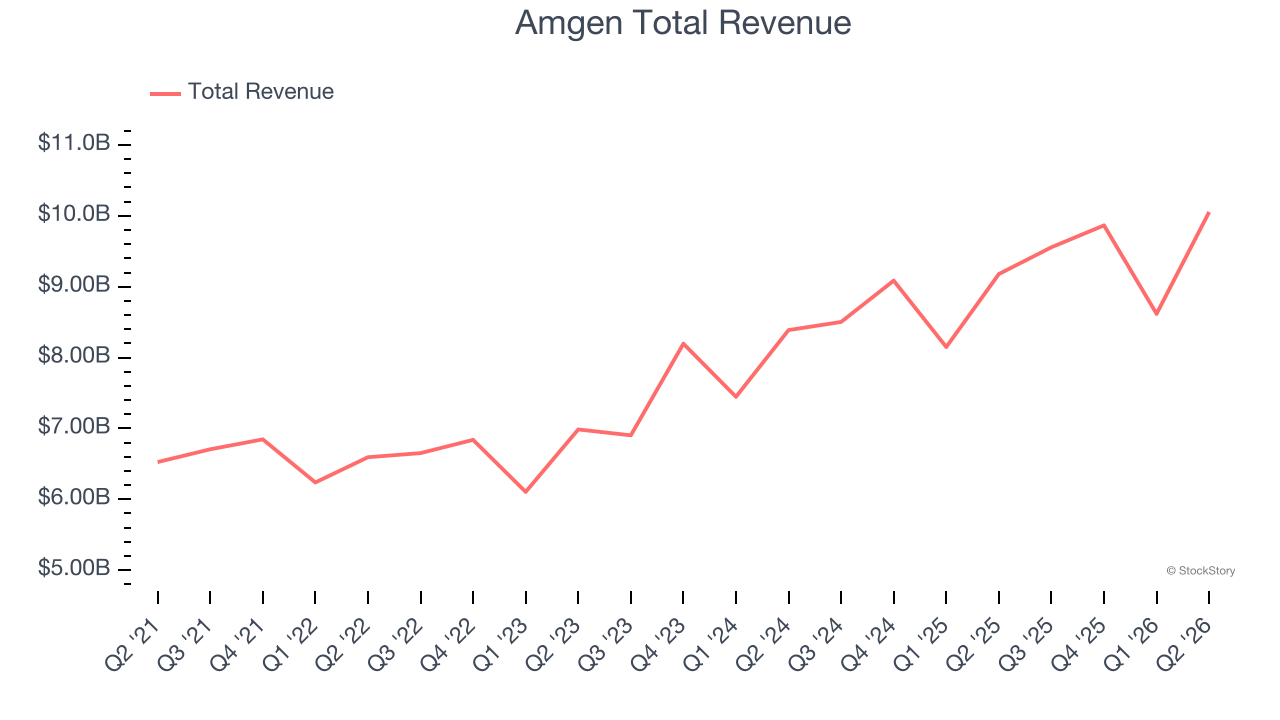
Interestingly, the stock is up 3.8% since reporting and currently trades at $404.75.
Is now the time to buy Amgen? Access our full analysis of the earnings results here, it’s free.
Best Q2: Biogen (NASDAQ:BIIB)
Founded in 1978 and pioneering treatments for some of medicine's most complex challenges, Biogen (NASDAQ:BIIB) develops and markets therapies for neurological conditions, including multiple sclerosis, Alzheimer's disease, spinal muscular atrophy, and rare diseases.
Biogen reported revenues of $2.74 billion, up 3.4% year on year, outperforming analysts’ expectations by 12.1%. The business had an incredible quarter with a beat of analysts’ EPS estimates and a solid beat of analysts’ full-year EPS guidance estimates.
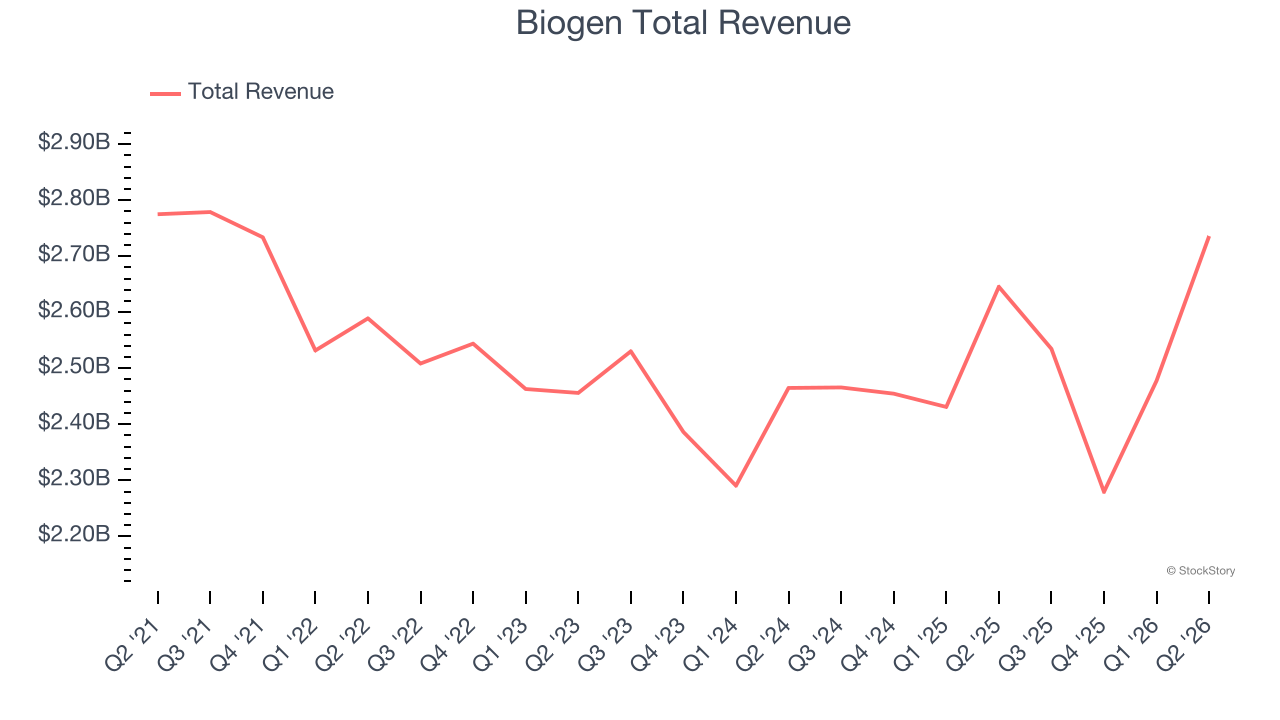
The market seems happy with the results as the stock is up 9.5% since reporting. It currently trades at $225.10.
Is now the time to buy Biogen? Access our full analysis of the earnings results here, it’s free.
Weakest Q2: Myriad Genetics (NASDAQ:MYGN)
Founded in 1991 as one of the pioneers in translating genetic discoveries into clinical applications, Myriad Genetics (NASDAQ:MYGN) develops genetic tests that assess disease risk, guide treatment decisions, and provide insights across oncology, women's health, and mental health.
Myriad Genetics reported revenues of $190.7 million, down 10.5% year on year, falling short of analysts’ expectations by 8.2%. It was a disappointing quarter as it posted full-year revenue guidance missing analysts’ expectations significantly and a significant miss of analysts’ EPS estimates.
Myriad Genetics delivered the weakest performance against analyst estimates and weakest full-year guidance update of the whole group. As expected, the stock is down 25.3% since the results and currently trades at $4.01.
Read our full analysis of Myriad Genetics’s results here.
Novavax (NASDAQ:NVAX)
Pioneering a nanoparticle technology that mimics the molecular structure of disease pathogens, Novavax (NASDAQ:NVAX) develops and commercializes protein-based vaccines for infectious diseases, with a primary focus on its COVID-19 vaccine and combination respiratory vaccine candidates.
Novavax reported revenues of $56.7 million, down 76.3% year on year. This print beat analysts’ expectations by 1.5%. It was a very strong quarter as it also put up a beat of analysts’ EPS estimates.
Novavax had the slowest revenue growth among its peers. The stock is up 36.7% since reporting and currently trades at $10.53.
Read our full, actionable report on Novavax here, it’s free.
Halozyme Therapeutics (NASDAQ:HALO)
Known for transforming hours-long intravenous infusions into minutes-long subcutaneous injections, Halozyme Therapeutics (NASDAQ:HALO) develops and licenses its proprietary ENHANZE technology that enables subcutaneous delivery of injectable drugs that would otherwise require intravenous administration.
Halozyme Therapeutics reported revenues of $481 million, up 47.7% year on year. This result topped analysts’ expectations by 19%. It was an incredible quarter as it also logged a beat of analysts’ EPS estimates and a solid beat of analysts’ full-year EPS guidance estimates.
Halozyme Therapeutics scored the fastest revenue growth and highest full-year guidance raise in the group. The stock is up 31.5% since reporting and currently trades at $112.81.
Read our full, actionable report on Halozyme Therapeutics here, it’s free.
Market Update
Over the past year, investors have been forced to repeatedly answer the same question: what is the market’s biggest risk? The answer has changed several times, and each shift has reshaped market leadership.
Late in 2025 and early 2026, artificial intelligence became the market’s primary uncertainty. Investors questioned whether AI would erode software pricing power and weaken competitive moats as AI made it easier to replicate once-differentiated products.
By the spring, technology took a back seat to geopolitics. The U.S. conflict with Iran briefly became the market’s dominant narrative, raising concerns about oil prices, inflation, and global growth. But as energy markets remained orderly and fears of a prolonged supply disruption faded, investors quickly turned their focus back to fundamentals.
Want to invest in winners with rock-solid fundamentals? Check out our 9 Best Market-Beating Stocks and add them to your watchlist. These companies are poised for growth regardless of the political or macroeconomic climate.