
— Why SkyDrive Chooses a Compact Multi-Rotor Architecture —
SkyDrive Inc. ("SkyDrive"), a leading compact eVTOL aircraft (*1) developer based in Japan, today published its Aircraft Design Concept paper, which is titled "The eVTOL Safety Dilemma in Congested Urban Environments." The paper outlines the engineering rationale behind choosing a compact multi-rotor architecture specifically optimized for operating in space-constrained urban settings.
This press release features multimedia. View the full release here: https://www.businesswire.com/news/home/20260923678720/en/
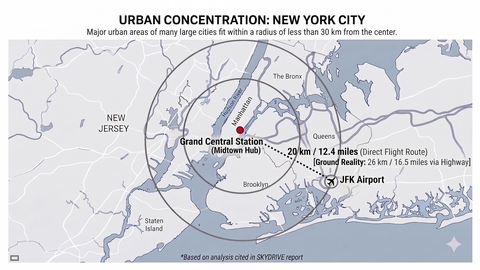
In the emerging eVTOL industry, there is no single "correct" aircraft architecture for every application. Design choices range from winged aircraft (such as tilt-rotor or lift-and-cruise configurations) focused on long-range cruising efficiency, to multi-rotor aircraft optimized for the operation in limited spaces. This SkyDrive’s Concept paper examines the engineering trade-offs between hovering performance, battery power density, and redundancy—explaining why a compact multi-rotor is the most suitable architecture for inner-city mobility use.
Designing Aircraft from the Perspective of "Where They Fly"
SkyDrive’s vision is to create the most accessible air mobility for daily urban use. According to the United Nations’ World Urbanization Prospects (*2), over 60% of the global population will live in urban areas by 2030. In high-density megacities, major commercial and residential hubs typically fall within a 30 km (18-mile) radius from the city center. SkyDrive targets this high-demand "last-mile" segment, seamlessly connecting major transit hubs (such as high-speed rail stations and airports) to final destinations like office rooftops and hotels.
Overview of the Design Concept
1. The eVTOL "Safety Dilemma" in Urban Operations
Winged eVTOL configurations offer clear advantages for long-range flights by utilizing wings to generate lift during forward cruise. However, operating in dense urban environments presents different priorities. In confined city spaces surrounded by obstacles, precise vertical approach, low-speed handling, and hovering capability become paramount. Incorporating tilting mechanisms or fixed wings adds structural weight and complexity, which in turn increases the power required during hover. Balancing forward cruise efficiency with urban hovering safety represents the core engineering dilemma addressed in the paper.
2. Hovering Efficiency and "Disk Loading" are the Keys for the Urban Area
In urban environments lacking runways, hovering efficiency is critical. A key parameter defining this is "disk loading"—the ratio of maximum takeoff weight to total rotor disk area. Lower disk loading distributes aircraft weight across a larger rotor area, significantly reducing the battery power needed to hover. SkyDrive’s design incorporates 12 rotors to secure a large total disk area, achieving low disk loading and maximizing hovering power efficiency.
3. Beyond Battery Capacity: How Power Output Drives Urban Operations
When considering the performance of eVTOLs, batteries have two major critical factors. One is "energy density," which indicates how much energy can be stored. This mainly affects the flight range. The other is "power density," which indicates how much power can be supplied instantaneously. In hovering and vertical takeoff and landing, which require large amounts of power, this power density becomes essential.
In aircraft with high disk loading, the required power also increases, and the battery's power performance can become a constraint for vertical flight. In other words, for eVTOLs used in cities, it is important to look not only at "how far the battery allows the aircraft to fly," but also at "how much power it can safely supply when needed.
4. Safety Redundancy and Single-Failure Tolerance
When considering aircraft safety, designs must be based on the premise that a failure will occur in part of the system. This Design Concept examines the redundancy of batteries and propulsion motors.
For example, even if a failure occurs in one of the battery packs, the remaining system alone must be able to continue safe flight and landing. A major hurdle here is the previously mentioned "power required for hovering." In densely built urban areas where emergency forward-landing runways are unavailable, an aircraft must be able to complete a safe vertical landing even if a power system component fails. SkyDrive’s design addresses this requirement by maintaining low disk loading, providing the necessary power margin to ensure stable hover and safe vertical landing directly onto a vertiport, even in single-failure scenarios.
5. The "Multi-Rotor" Choice Derived from Short-Range Urban Travel
Aircraft architecture is inherently sized by its most demanding flight phase: hovering. High disk loading requires an oversized, heavier propulsion system to achieve takeoff thrust, which significantly reduces the Payload-to-MTOW (Maximum Takeoff Weight) ratio—a weight penalty that persists even during forward cruise. For short-range urban travel (under 30 km), carrying heavy, oversized propulsion systems yields diminished returns. By optimizing the powertrain for hover through a low disk loading approach, SkyDrive minimizes total propulsion weight and maximizes payload efficiency.
Furthermore, the compact footprint of our multi-rotor minimizes the physical space required for takeoff and landing, providing a distinct advantage in space-constrained urban environments. While winged aircraft excel in long-range regional missions exceeding 50 km, SkyDrive’s multi-rotor architecture offers the most pragmatic and safe solution for short-range inner-city hops, where precise landing in limited urban spots is essential.
Towards a Future of "Taking the Sky for Daily Transportation"
SkyDrive focuses not only on "how far we can fly," but also on "where we can take off from." Looking ahead to daily operations in urban environments, SkyDrive aims to realize "the most accessible air mobility, allowing people to take off directly from the city," by prioritizing safety-first, short-range aircraft development and seamless integration with existing transportation networks. Through these efforts, we will pave the way toward a future where taking the sky becomes a part of everyday mobility.
To read the full overview of SkyDrive's Aircraft Design Concept, please visit:
URL: https://skydrive.co.jp/en/wp-content/themes/skydrive-en-v20260706/assets/pdf/EN_Design_Philosophy_Paper2.pdf
About SkyDrive Inc.
SkyDrive is a Japanese compact eVTOL company aiming "to take the lead in the once-in-a-century mobility revolution." The company began testing eVTOL prototypes in 2014 prior to official incorporation in 2018. Under its future vision for urban transportation, flying in eVTOLs will become a regular part of city life. In 2019, SkyDrive became the first company to fly a crewed eVTOL in Japan. In 2025, the company successfully showcased SKYDRIVE, the company's first commercial eVTOL product, with demonstration flights at the Osaka Expo witnessed by thousands of visitors over a one-month period. SkyDrive began production of SKYDRIVE in March 2024 at a plant owned by Suzuki Motor Corporation, SkyDrive's official production partner. SkyDrive has been working with civil aviation authorities in Japan and the U.S. to obtain certification for SKYDRIVE, with the aim of launching the aircraft into service in 2028. SkyDrive is headquartered in Toyota, Aichi Prefecture and led by CEO Tomohiro Fukuzawa, an engineer and entrepreneur.
For more information, please visit: https://skydrive.co.jp/en/
Editor’s Notes: |
(*1) eVTOL is an abbreviation for electric vertical takeoff and landing. As the name suggests, eVTOL aircraft can take off and land without a runway. eVTOLs are powered by electricity and incorporate advanced, automatic, flight control technology. |
|
(*2) United Nations, Department of Economic and Social Affairs, Population Division (2018). World Urbanization Prospects: The 2018 Revision. Official website: https://population.un.org/wup/ |
View source version on businesswire.com: https://www.businesswire.com/news/home/20260923678720/en/
Contacts
Kaori Saito
Public Relations
SkyDrive Inc.
Email: info@skydrive.co.jp
https://skydrive.co.jp/en/contact
If you believe this article contains misleading, harmful, or spam content, please let us know.
Report this article